IMPACT (carbonic maceration) 150g

IMPACT (carbonic maceration) 150g

Vendor
Broadway Coffee Roasters
Regular price
£32.80
Sale price
£32.80
Regular price
Sold out
Unit price
per 

About This Coffee

Founded in 2000, Campo Hermoso has grown into a beacon of specialty coffee under the leadership of Edwin Noreña. Originally producing washed coffees for the commodity market, the farm shifted its focus in 2014 to specialty coffee, embracing innovation and quality. Today, Campo Hermoso is celebrated for its flagship varieties: Bourbon Sidra and Rosado, Sudan Rume or, in this case, the rare and mysterious Papayo, all crafted through cutting-edge cultivation and processing techniques.

The origins and genetic lineage of the Papayo variety are, at the time of writing, a mystery. 'Discovered' in the municipality of Acevedo, the variety is named for its distinctive shape. Unlike the round, spherical cherries of most Arabica trees, Papayo cherries are elongated and pointed, closely resembling a miniature papaya. The trees are remarkably hardy and vigorous, with a structure similar to Caturra but with greater resistance to strong winds and certain localized pests. The cherries often take slightly longer to ripen, allowing for a higher concentration of sugars (Brix content). While its exact migration to Colombia remains a mystery, it has successfully adapted to the high-altitude terroirs of Southern Huila, becoming a localized treasure.

For many years Papayo was thought to be a natural mutation of Caturra (itself a natural mutation of Bourbon). More recently it has been claimed it is genetically distinct from the Bourbon/Typica lineage found in Latin American and related more closely to Ethiopian Landraces. However, without substantial evidence in the public domain, such claims will remain hypotheses. All we know for sure: it's delicious!

The Process

The cherries are harvested at over 20° Brix and soaked in water for 2 hours for cleaning and sorting. They undergo an initial anaerobic fermentation for 48 hours. Subsequently, a carbonic maceration is carried out for 72 hours. After the fermentation process, the coffee is processed by pulping and washing. It is then dried in a green house under controlled conditions for 10 days. 

The Region

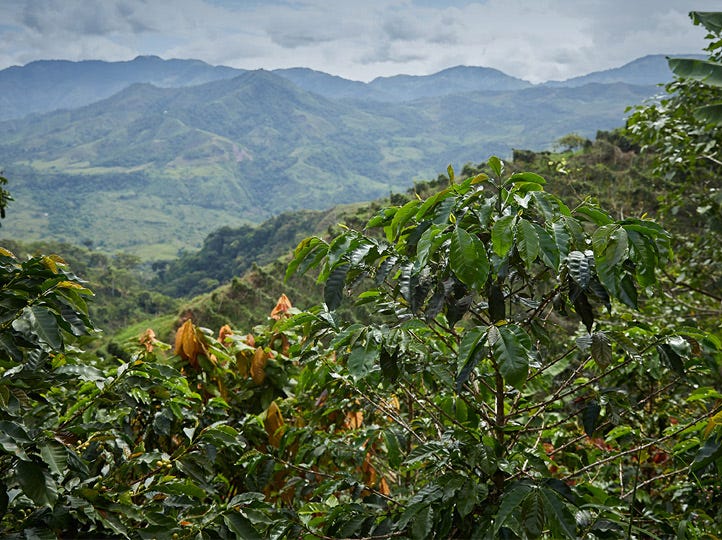
Quindio is in the west central region of Colombia, on the western slopes of the Andean Cordillera. Although it is the smallest department in the country, it is considered one of the pioneers of Colombian coffee and helped make Colombian coffee world renowned. Quindio may not be as significant but the region still produces very impressive coffee.
History of Coffee in Colombia

As with many coffee origins, it is believed that coffee was first brought to Colombia by priests, arriving, perhaps, within a decade or two after coffee first came to the Americas via the Caribbean in the first half of the 17th century. It was likely a garden crop grown for local consumption and barter for decades. Unlike other coffee regions, we have the story of a priest named Francisco Romero, who could be called the father of commercial coffee cultivation in Colombia. The folkloric tale goes that in the early 1800’s, Father Francisco, hearing confessions in the north eastern town of Salazar de la Palmas, assigned planting coffee to his parishioners as penance for their sins. The Archbishop of Colombia heard about this and ordered all priests to adopt the practice. Commercial production of coffee expanded quickly, moving into regions where the growing conditions were ideal.